Section 07: Artificial Intelligence
AI Exposure
The other side of the AI discussion concerns how this technology could affect job demand and employment
EL reviewed recent research papers that assess which occupations may be most at risk. Most of these studies examined the skill requirements of each occupation and compared them with the types of skills that LLMs and similar forms of AI can augment or automate. Many papers described this dynamic using the term “exposure,” a measure intended to capture the potential impact of the technology rather than predict whether jobs will be replaced by these tools.
One paper emerged as the gold standard and was referenced in most subsequent studies. In the seminal “GPTs are GPTs” study, Eloundou et al. (2024) estimated the percentage of tasks performed by each occupation that are exposed to LLM software. Exposure was defined as a 50% reduction in the time required to complete a task (the GPT Beta Score). This report provided EL with a framework for assessing exposure for each occupation in the economy, which could then be applied to North Carolina’s tech workforce to better understand potential AI impacts.
The exposure scores highlight the types of jobs with the highest potential for task augmentation or automation from AI. Tech occupations such as computer programmers, web developers, mathematicians, and software developers are among the most exposed. Other positions involving clerical or writing work also have high exposure levels. This means that non-tech workers within tech companies—not just tech-specific roles—could also be affected.
Occupations with the Highest AI Expsoure Scores
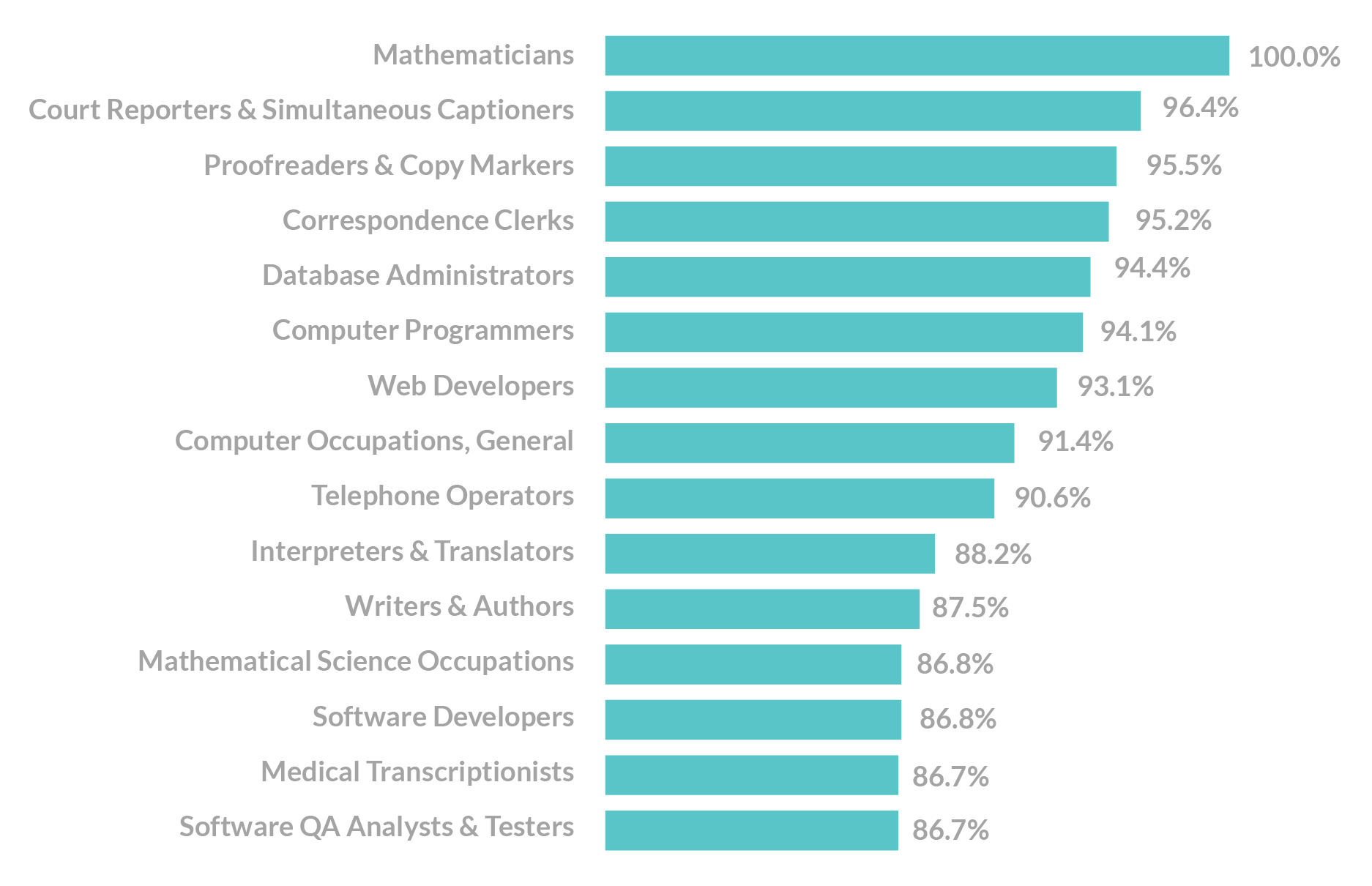
Source: Eloundou et al. (2024)
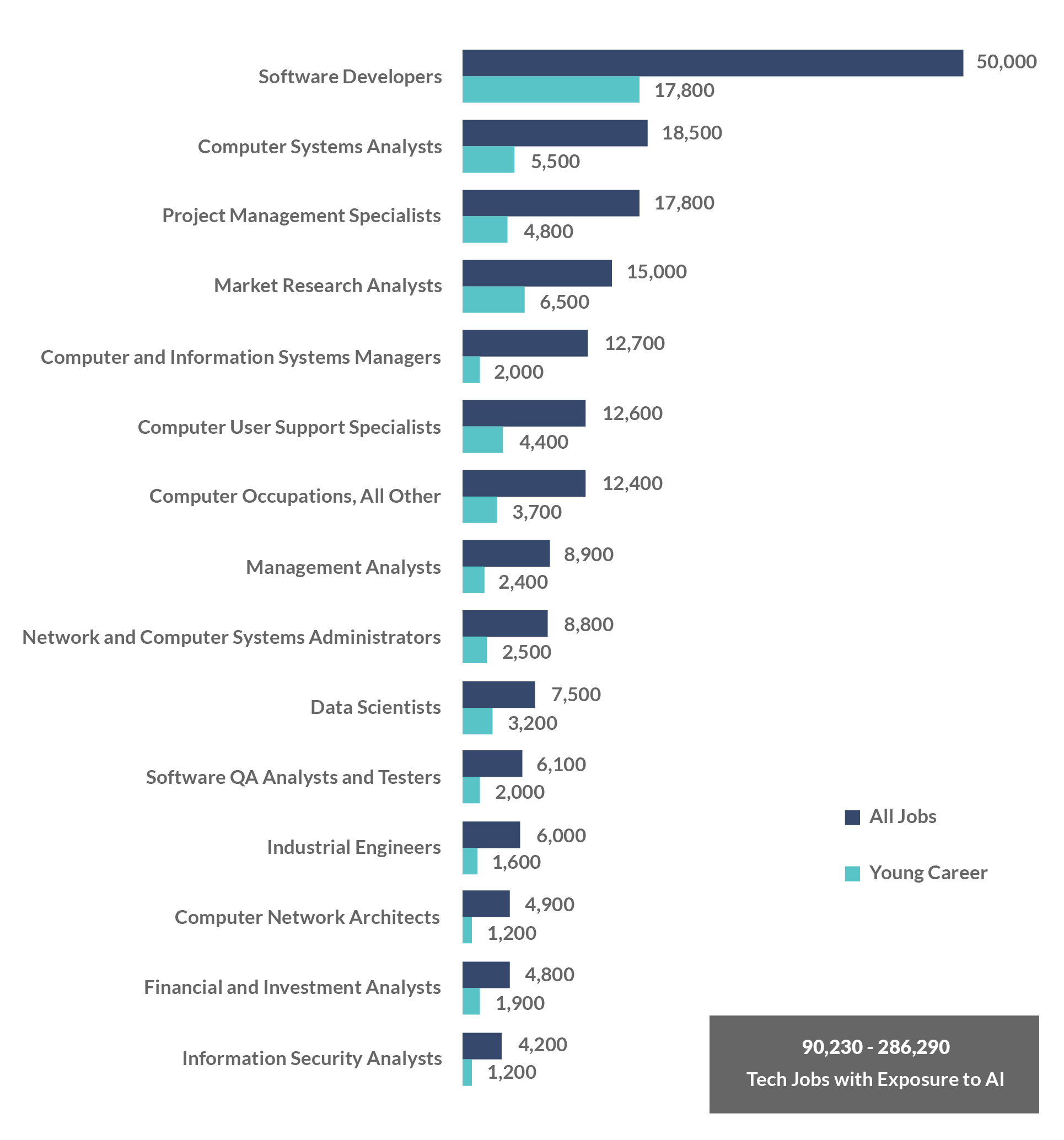
The exposure scores for AI technology were applied to North Carolina’s 2024 labor market data to estimate the number of jobs that could heavily utilize AI
Because each exposure score represents the share of tasks affected, we applied these percentages to employment levels to estimate the number of jobs potentially exposed. Based on 2024 employment levels, approximately 286,290 tech jobs in North Carolina are predicted to be exposed to LLM technology. This represents about 61% of the state’s current tech workforce.
While mathematicians have the highest exposure score, they represent a small share of North Carolina’s workforce and therefore are not among the most impacted occupations. Exposed job estimates were rounded to the nearest hundred to emphasize that these figures are broad assessments rather than precise measurements. Among the top exposed occupations are software developers, research analysts, and data scientists. These are roles that have historically driven growth in the state’s tech sector. If exposure leads to even modest levels of job replacement, it could significantly impact the state’s employment figures.
Research from Brynjolfsson et al. suggests that only younger workers are currently experiencing job impacts related to AI. Based on this finding, a reasonable lower bound of exposure was estimated by applying AI exposure only to young workers. To produce this lower-bound estimate for North Carolina’s tech jobs, occupation data were shifted from all ages to only those workers between ages 14 and 35. This age grouping was the closest approximation to the paper’s age brackets that can be generated using labor market data. This creates a lower-impact scenario in which only early-career jobs would be affected by AI exposure. If AI ultimately augments or automates only early-career tasks, the potential exposure for North Carolina would be much smaller—about 90,230 tech jobs. This represents roughly 19% of all tech jobs in the state.
For years, tech jobs have offered stable, higher-paying career opportunities, and many young people have taken on college debt to train for positions in tech fields. If AI exposure in these occupations leads to fewer job opportunities, young workers may face significant challenges in repositioning their careers and achieving economic security. North Carolina will need to be prepared to train the next generation of AI experts to support its local companies, while also identifying ways to retrain workers whose jobs may be displaced
North Carolina Tech Occupations with Greatest AI Exposure